Why You Eat When You’re Stressed (And What to Do Instead of Fighting It)
It’s 9pm. The day was hard — long, frustrating, or just quietly relentless in the way some days are. And somehow you’re standing in the kitchen eating crackers directly from the box, not because you’re hungry, but because something in you just needed to.
Sound familiar?
If it does, I want to say something clearly before we go any further: there is nothing wrong with you. Stress eating isn’t a character flaw, a lack of willpower, or evidence that you have a “bad relationship” with food. It’s a deeply human response to a hard day — one that’s been wired into us for reasons that made a lot of sense, even if the modern version of it (crackers at 9pm instead of, you know, outrunning a predator) feels a bit less justified.
Let’s start with why it happens. Because understanding that is the only useful starting point.
Why stress eating happens — the biology
When you’re stressed, your body does something very specific. It releases cortisol — the primary stress hormone — which, among many other things, increases your appetite and, in particular, your craving for foods that are high in sugar, fat, or both.
This isn’t a design flaw. It’s a survival mechanism. In an ancestral context, stress usually meant physical danger and genuine energy expenditure — running, fighting, moving quickly. Cortisol’s job was to make sure your body had the fuel for that. The cravings that come with stress were useful because they pointed you toward calorie-dense foods that could be used for actual physical action.
The problem, of course, is that most modern stress isn’t physical. A difficult conversation, a long commute, a work deadline, a sleepless night — these activate the same cortisol response as physical danger, but without the physical expenditure that was supposed to follow. So you get the appetite spike without the energy burn, which means food that was biologically supposed to fuel a sprint ends up being eaten in front of a laptop instead.
This is not a moral failure. It’s a mismatch between ancient biology and modern life.
There’s also a second layer to this. Eating — specifically, eating foods that are sweet, fatty, or salty — genuinely does reduce stress in the short term. It activates the brain’s reward system, releasing dopamine. It provides sensory comfort. For many of us, food is also emotionally associated with safety, care, and comfort from childhood — so reaching for it when we feel bad isn’t irrational at all. It’s actually quite logical, even if it doesn’t always serve us in the long run.
The difference between stress eating and a problem
Before we go any further, it’s worth drawing a line here.
Occasionally eating more than you’re physically hungry for when life is hard is normal. It’s human. It does not make you someone with a disordered relationship with food.
The territory that becomes worth paying attention to looks different: eating in a way that feels completely out of control, eating past the point of significant discomfort consistently, feeling intense shame or distress afterward, or finding that stress eating is the only coping tool you have available and it’s happening every single day.
If that resonates, I’d gently encourage you to speak with a therapist or counsellor who specialises in this area — not because something is wrong with you, but because you deserve more tools than one. This article isn’t a substitute for that support.
For the rest — the occasional evening in the kitchen when the day has been too long — let’s talk about what’s actually helpful.
What to do instead of fighting it
The first thing I want to say here is what NOT to do: don’t try to white-knuckle your way through a stress eating urge purely through restriction. “I won’t eat anything after 8pm” as a rigid rule, applied during a stressful period, tends to make the eventual eating feel more compulsive and more guilt-laden, not less. Restriction rarely fixes the feeling underneath.
Here’s what I’ve found actually helps — both in my own life and in the conversations I’ve had with clients over the years.
Pause for two minutes before acting on the urge
Not to talk yourself out of it — just to notice it. What are you actually feeling right now? Is it hunger, or something else? Tired, lonely, overwhelmed, bored? You don’t have to fix the feeling. Just naming it creates a tiny gap between the feeling and the automatic response, which is often enough to make the eating feel like a choice rather than a reflex.
Ask: what does my body actually want right now?
Sometimes the honest answer is food, and that’s completely fine. Sometimes it’s something else — sleep, a conversation, a break from a screen, a change of scene. Stress eating often happens when we reach for the easiest available comfort, which happens to be food, not necessarily because food is what the moment actually needs.
If you’re going to eat, eat something that feels good afterward too
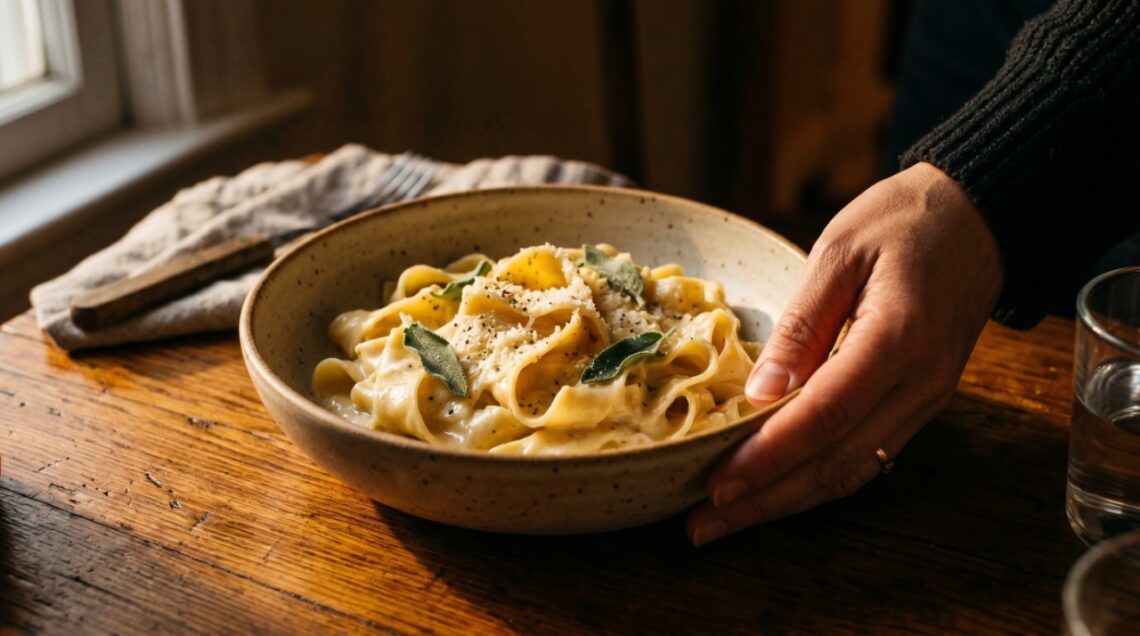
This isn’t about choosing “healthy” food as some kind of moral corrective. It’s about choosing something that will feel genuinely satisfying rather than something that leaves you feeling worse. The box of crackers at 9pm often doesn’t actually satisfy the craving — it just extends it. A small bowl of something warm, or something with a bit of substance, often does more.
Build a small library of non-food comfort habits
Not as replacements you’re forced to use instead of food — but as genuine alternatives that feel good in moments of stress. A short walk. A warm shower or bath. A specific playlist. Five minutes of something completely absorbing. These aren’t techniques to suppress a feeling; they’re tools that actually address the underlying need (relief, comfort, sensory calm) in a way that sometimes works better than eating does.
Stop treating stress eating as evidence that you failed
The guilt cycle that follows stress eating is often harder on your relationship with food than the eating itself. Shame doesn’t lead to better choices — it leads to more stress, which leads to more urge to eat, which leads to more shame. Eating crackers at 9pm is just something that happened. It ends there, unless you decide to add a layer of judgment on top of it.
A note on the bigger picture
I’ve worked with a lot of people who frame their goal as “stopping emotional eating.” And I want to be honest with you: I’m not sure that’s the right goal.
Emotional eating — eating that’s connected to feeling something — is part of being human. We celebrate with food. We grieve with food. We comfort ourselves with food. These aren’t pathologies. They’re expressions of the fact that food has never been just fuel.
The goal, I think, isn’t to separate food from emotion entirely. It’s to make sure food isn’t the only tool you have when things get hard. And to stop making yourself wrong for a coping mechanism that, honestly, makes a lot of sense.
Food isn’t the enemy. It never was. Even at 9pm, standing in the kitchen, eating crackers from the box.
If you want to talk about this more
This is one of my favourite topics to go deeper on — Pillar 3 is the part of my work I find most meaningful, because it’s where the real shifts happen for people.
Leave a comment below if this resonated, or come find me on Instagram @jennifernesh.eats — I’d love to hear what comes up for you.
For more honest conversations about food, alongside recipes that make eating well feel like joy rather than discipline, everything is at jnesh.com.
Healthy meals, made easy. That’s the promise. 🌿
— Jennifer
This article is for general information and isn’t a substitute for professional mental health support. If stress eating is significantly affecting your quality of life, please consider speaking with a qualified therapist or counsellor.